
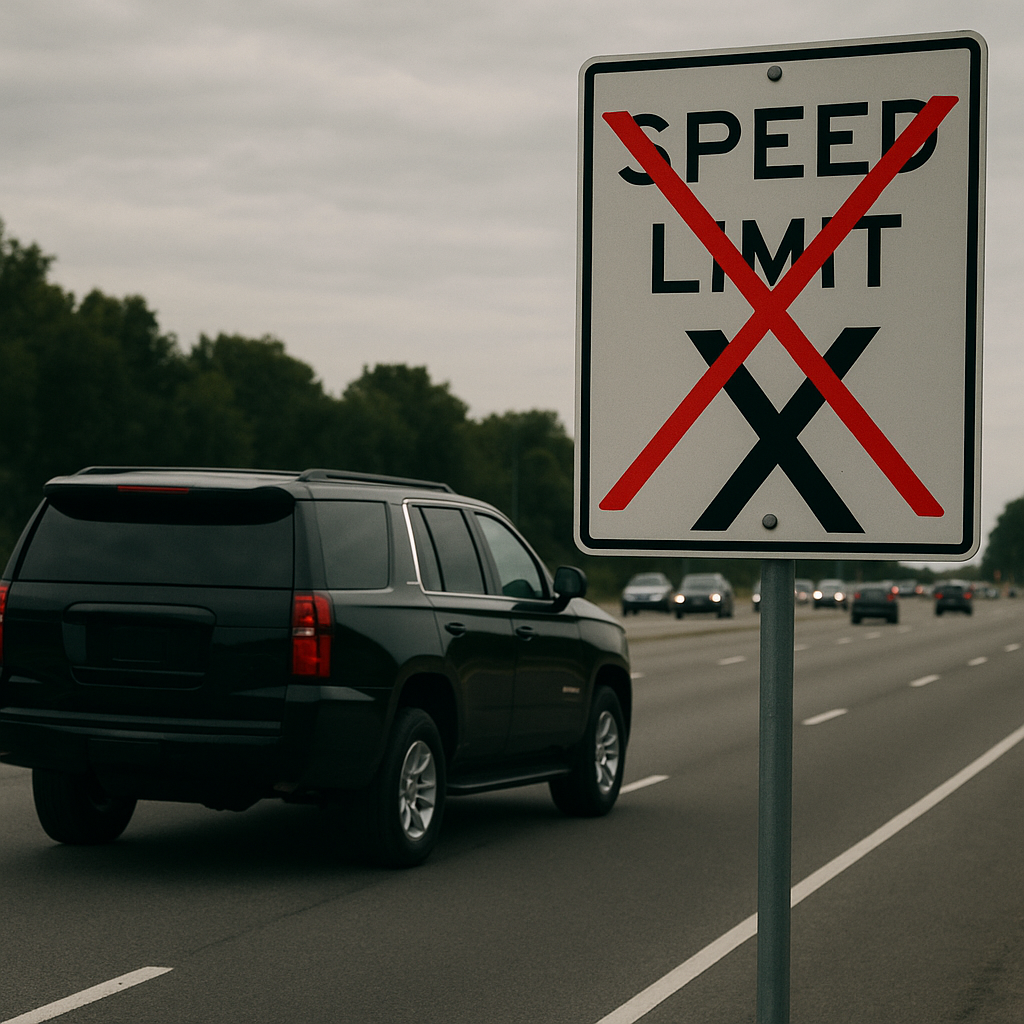


Just Another Car on the Road: No Speed Limit
My wife had to take the kids out in preparation for the start of school. When she returned, I casually asked how the trip went.
Her response threw me into a tailspin of thoughts:
“There should be no speed limits.”
(Explosion!!)
My first inclination? Dive headfirst into the origin of speed limits. Fun fact: Connecticut established the first numeric speed limit back in 1901—12 mph in cities, 15 mph in rural areas. Allegedly for safety. Later, in the 1970s, the national limit was born—not for safety, but due to an oil crisis. Fuel conservation disguised as public order.
Sorry—nerd moment. Let me get back to my wife’s point.
“There should be no speed limits,” she repeated.
“Why, Love?” I asked.
“It’s just a trap.”
(Explosion!! Again.)
Fun fact, the first citation for speeding was delivered in 1904 in Dayton Ohio. The recorded incident states that driver was going 12mph, not allowed in that city at that time. I am getting off track again – my bad.
My wife wasn’t done. “If we must have speed rules, then before someone gets a license, there should be uniform skill assessments and driving mandates—not for profit, but for real safety and structure.”
Of course, the conversation spiraled into a full-blown rant about how speed limits are just another form of control—about how they’re monetized, weaponized, and sensationalized for gain. Not for protection. Not for people. But for power.
As her words echoed, I started to relive my own experiences on the road. Times I’ve had to speed up—not out of recklessness, but to avoid a collision. Times I’ve slowed down—not because a sign told me to, but because of a curve or a gut feeling.
I adjust my speed based on the situation I’m in. Not based on someone else’s blanket decree.
Isn’t that just like life?
Day to day, we’re pressured to move at speeds someone else set. Timelines. Expectations. Bureaucratic rhythms. We’re told to stay in step, not for our own good, but to keep the “system” running smooth—for someone else. There is even a threat of penalty if we don’t acquiesce to the proposed governance. They’ll say it’s for safety. For structure. For the greater good.
These speed limits, they don’t consider your road conditions; your detours; your passengers. So, to be blunt, I am driving this vehicle and there is no speed limit, only appropriate pacing for the traffic lanes that I’m navigating.
This is Ralph, and I am just another car on the road.